
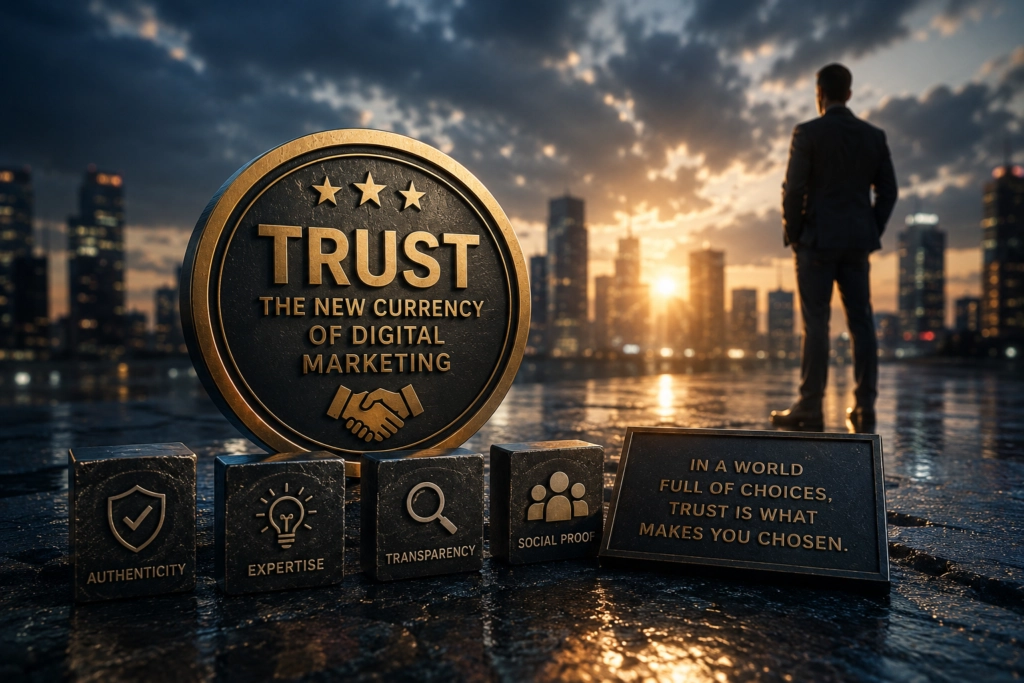
Introduction: From Chasing Eyeballs to Earning Belief
Trust Economy For a long stretch of digital marketing history, the game was simple: win attention. Brands poured budgets into ads, social campaigns, and SEO, all chasing the same goal — get as many eyes on the page as possible. Attention still matters, of course, but it’s no longer the finish line it used to be.
Today’s consumers are sharper and more skeptical than ever. They’re bombarded with marketing messages constantly, and that constant exposure has changed their behavior — visibility alone doesn’t move them anymore. Before they commit time, money, or loyalty, they want proof of credibility. That shift has given rise to what’s now widely known as the Trust Economy.
What the Trust Economy Actually Means
In this new marketplace, credibility carries more weight than any ad campaign. Buyers are actively looking for authenticity, transparency, and real expertise before they decide who to buy from — which means businesses that build genuine trust hold a real edge over competitors who don’t.
Part of this comes down to how much information is now at a buyer’s fingertips. People read reviews, compare alternatives, watch demo videos, and dig through social proof before ever reaching for their wallet. That kind of research habit means brands have to earn trust rather than simply buy visibility. No matter how much traffic a company drives, if it hasn’t built credibility, converting that traffic into customers becomes an uphill battle.
People Trust People — Not Logos
One of the clearest shifts in marketing today is how much more consumers trust individuals over corporate branding. A founder, business owner, or recognized expert speaking directly often connects better than a polished ad ever could.
Social media has only sped this up. Audiences follow creators and thought leaders because they want authentic perspective, not scripted messaging. Brands that put real people front and center — rather than hiding behind a logo — tend to build far stronger emotional connections with their audience.
What Weak Credibility Actually Costs
Trust Economy A lot of businesses pour resources into traffic generation while neglecting trust entirely. That’s a costly mistake. Visitors can land on a page, browse around, and still walk away without buying or reaching out — because nothing convinced them the brand was worth trusting.
Low credibility also drives up acquisition costs. When people don’t trust a brand, it takes more advertising spend to achieve the same results a trusted competitor gets more cheaply. The downstream effects are real: lower conversion rates, weaker retention, slower growth. Brands that have already earned trust simply convert better and keep customers longer.
Social Proof: Trust You Can Point To
Social proof might be the single most effective trust-building tool available to marketers today. People look to others’ experiences when deciding what to do — which is exactly why testimonials, reviews, and case studies carry so much persuasive weight.
Positive experiences also compound. When prospective customers see real success stories from people like them, their own confidence in the brand grows. That’s why businesses should be deliberate about collecting and displaying testimonials, client feedback, and concrete project outcomes — they’re evidence, not just decoration.
Expertise Signals That Someone Knows What They’re Doing
Trust also comes from demonstrated knowledge. Customers want reassurance that they’re dealing with people who genuinely understand their field, which means brands need to consistently share useful insights and practical solutions, not just sales pitches.
Educational content — blog posts, research, webinars, tutorials — is one of the clearest ways to build that authority. When a business consistently teaches rather than just sells, its audience starts to see it as a trusted advisor instead of just another vendor. That perception pays off in stronger, longer-lasting relationships.
Why Transparency Wins
Honesty is no longer optional in digital marketing — it’s expected. Customers want clear communication about pricing, process, and what they’re actually getting, and businesses that deliver that clarity build stronger relationships as a result.
Transparency also removes friction caused by uncertainty. When a company is upfront about limitations or admits when something went wrong, it signals integrity rather than weakness. Counterintuitively, that kind of honesty tends to build more trust than a polished, flawless image — people respond to authenticity more than perfection.
Content Marketing as a Trust-Building Engine
In the Trust Economy, content marketing isn’t about pushing promotions — it’s about educating and adding value first. That reframing is what makes content such a powerful credibility tool.
Consistency matters here too. Whether it’s blogs, videos, podcasts, or social posts, showing up regularly with useful content signals commitment and expertise. Over time, audiences become familiar with a brand and start to trust it — and that trust eventually shows up as stronger engagement and better conversion numbers.
Website Design Is a Credibility Signal
For most businesses, the website is the first real interaction a prospect has with the brand. That means design quality isn’t just aesthetic — it directly shapes how trustworthy a visitor perceives the business to be.
A polished, well-built site — fast, easy to navigate, secure, professionally branded — signals competence before a single word is read. Visitors relax and engage more comfortably when a site feels reliable. Good design doesn’t just capture attention; it reinforces credibility at every step of the customer’s journey.
Consistency: Trust’s Quiet Backbone
Trust isn’t built in a single interaction — it accumulates over time through repeated, consistent experiences. That’s why businesses need to keep their messaging aligned across every channel: website, social media, ads, and direct customer interactions alike.
When customers encounter the same tone, values, and promises no matter where they interact with a brand, their confidence in that brand’s reliability grows. That consistency, more than any single campaign, is what turns short-term trust into long-term loyalty.
Where Digital Marketing Is Headed
As AI, automation, and other digital tools keep reshaping the landscape, competition and noise will only increase. In that environment, credibility becomes even more valuable — not less.
Businesses that lead with transparency, expertise, and genuine customer care will be the ones that keep winning, regardless of which platforms or tactics rise and fall. Trends change constantly, but trust holds its value.
Conclusion: Trust Is the Real Asset
Digital marketing has moved into a new phase. Attention still opens the door, but it no longer guarantees results — credibility is what actually closes the deal. Companies that invest seriously in building trust see the payoff in stronger relationships, better conversion, and a competitive advantage that’s hard to replicate.
At its core, the Trust Economy rewards businesses that consistently show up as authentic, knowledgeable, and reliable. Earning that trust means gaining more than customers — it means gaining advocates who stick around. In a market full of options, credibility remains the one advantage that never goes out of style.